-
Pilates Musings #2: Kyphotic Senior
Here’s a cute little recap of sorts I put together for a private session tailored to a 65-year-old male with noteworthy thoracic kyphosis and a mild loss of lower body strength with imbalance/asymmetries due to a past knee fracture on the left leg.
I’ve incorporated learnings from various resources e.g. courses and workshops I’ve attended, whether in person or online. Suffice to say, there are so many amazing resources available and it’s been a joy getting to apply these.
For this client, the primary goal was to address kyphotic posture gently and progressively through supported extension (well enabled by apparatus like the Barrel and Cadillac), while the secondary objective was to build functional leg strength to support balance and mobility in daily life, while working to reduce existing asymmetries.
Goal 1: Address kyphotic posture & build thoracic extension capacity
Top exercises if I had to choose:
1) Forward Push Thru on the Cadillac which
- Combines both flexion and extension to allow the client to more naturally unfold into extension.
- Option to add on rotation in a saw stretch variation which is great for thoracic mobility.
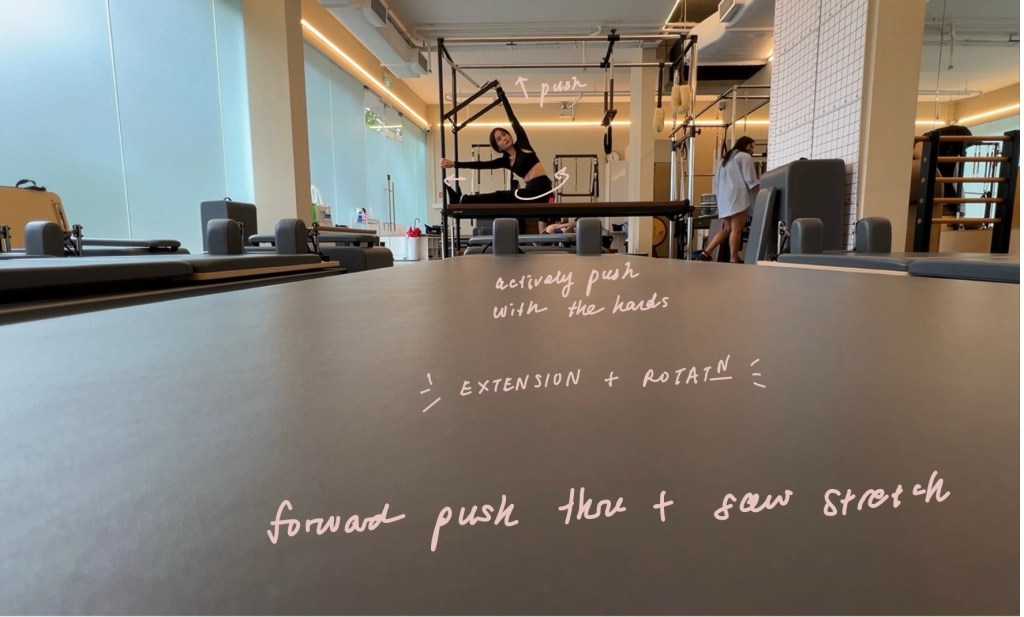
2) Arc Barrel for supported extension/rotation. In prone positions (tummy down on a flat mat), extension exercises can be really tough and uncomfortable for kyphotic clients. Lying prone on the barrel provides a more accessible entry point to these exercises, and allows a gradual progression in building up thoracic extension capacity. I also love Arm Circles on the small barrels for the chest opening due to the tightness of pectoral muscles in these kyphotic postures.
Of course, there are so many more exercises you can do, e.g. we could combine the use of the barrel with the springs on the Cadillac as a progression.
Apart from the exercises themselves, it would be important to build the client’s awareness of their scapula position. Ideally, the client can “sense their shoulder blades coming together”.
Goal 2: Lower Body Strength Asymmetries
Equipment like the Cadillac and Chair are actually amazing for working with asymmetries in lower body strength in bilateral movements. For instance, you can use a split pedal for bilateral footwork on the Chair. Meanwhile on the Cadillac, the leg springs offer independent resistance from a stable frame while on the reformer, the straps work with a moving carriage to create a connected system that can often hide unevenness. This means that the Cadillac’s separate springs demand more torso stabilisation and control. At the same time, strength demands e.g. on hip extensors to press the straps down in the sagittal plan also increase as the leg springs are heavier than those on the reformer.
A classic for knee strengthening would be the Forward Step Up on the Chair – sometimes referred to as the lunge on the chair. In a private session, the client can get the most out of this with tactile feedback to guide them through the natural bony rhythms of the knee (there is a spiral that takes place deep within the knee – femur spirals in, tibia spirals out as the client steps up onto the chair) and focus on knee alignment as the knee joint goes from flexion to extension.
I particularly like the Foot Press on Long Box – this would ideally be taught with client lightly relying on the chair handles first for balance and stability. Apart from training lower body strength (gluteus medius to stabilise, glute max to extend the hip, vasti of the quads to extend the knee, hamstrings to bend), there’s a lot of deep core work to stabilise in the coronal plane.
Goal 3: Breath & Ribcage Expansion
This involves lateral and posterior ribcage breathing, breath-to-movement integration, as well as an understanding of breath to support extension and mobility. For kyphotic postures, this is especially helpful.
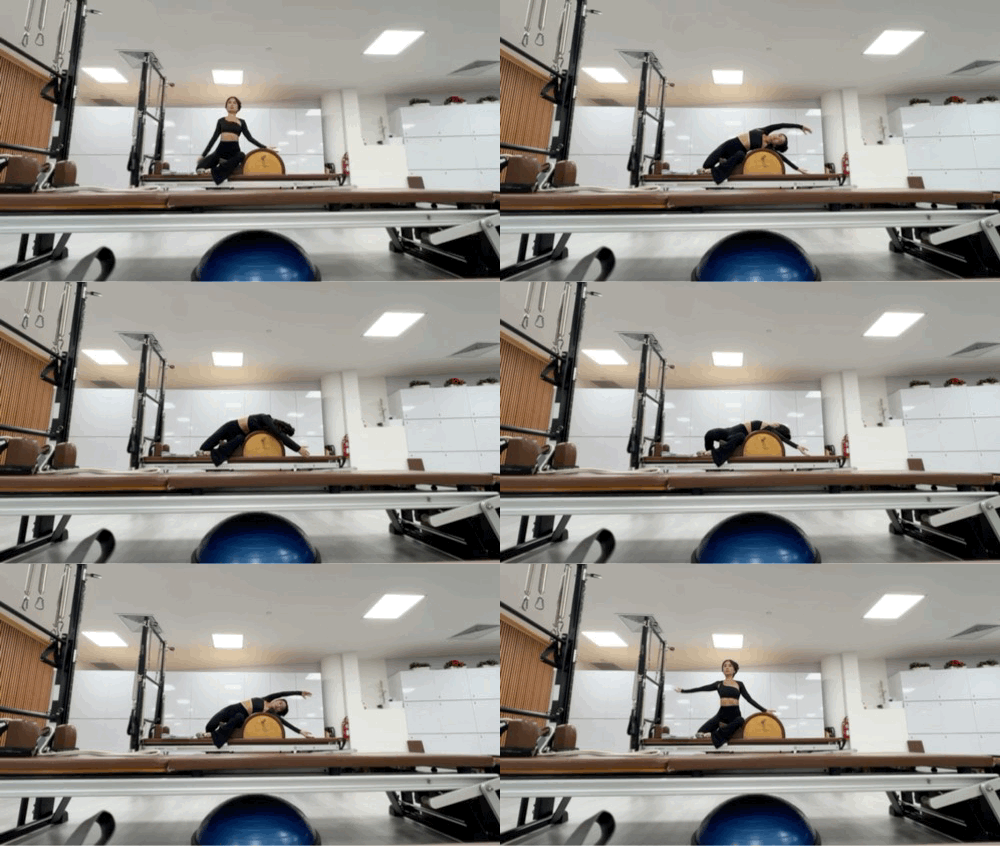
The Breathing Side exercise on the Arc Barrel feels incredible for chest opening. I’ve included an image above to depict this, but do note that I had too much hip rotation here and my lateral flexion onto the barrel could have had much better detail. I love how using a curved accessory like the arc barrel provides feedback which allows for a fuller range of movement.
-
Pilates Musings #1: Multi-Equipment Pilates
One of the things I love most about being a Pilates teacher is the seemingly endless array of options to support your teaching objectives. Incorporating Chair, Barrel, and Cadillac into my teaching has been a game changer. Each piece highlights Pilates principles in a new way, creating a layered, nuanced, embodied learning experience.
- Cadillac: Provides a secure yet versatile environment with its stable frame, vertical bars and raised frame with suspension aids. It’s a fantastic way to develop spatial orientation, as the roll down bar and push thru bars educate the mover to understand where their body is in space. And of course, hanging work allows for full body integration for advanced practitioners.
- Chair: In comparison to the other equipment, the Chair has a small surface area and therefore provides very little external support. It also uniquely shifts the relationship with gravity due to its upright orientation. The highlight is the moving pedal that is spring loaded – this creates a dynamic and unpredictable movement environment that forces one to find one’s centre and control.
- Barrel: Curved accessory that is unique among Pilates equipment in that it does not have springs. As such, it offers a different quality altogether. Its shape provides supported mobility, allowing for greater range with less muscular effort while also offering enhanced feedback. In essence, great for flexibility and postural awareness.
Since moving between different equipment does entail quite a bit of context switching, I find it useful to pay attention to transitions and pacing to ensure the session feels cohesive rather than fragmented.
What I love most is exploring similar exercises across different equipment and noticing how the experience changes. Movement patterns like spinal flexion and hip extension exist across all apparatus. The biomechanics differ due to changes in support, load, and body orientation relative to gravity. For instance, a seated Cadillac exercise has a wide base of support and low balance demand, allowing focus on mobility or strength. A standing Chair exercise has a narrow base of support and higher centre of mass, increasing balance and stabiliser demand.
For example:
Footwork
- On the Reformer, there is this clear, linear resistance and a sense of flow.
- On the Chair, this becomes a grounding, upright strength challenge.
- On the Cadillac, done as Leg Presses – supine with feet on the push thru bar (springs from below), it becomes a lesson in precision and control against a different directional pull.
Spinal Extension & progressing to Swan Dive:
- The Arc Barrel offers an entry point for spinal extension exercises, particularly for kyphotic clients where lying prone on the mat is already uncomfortable.
- On the Cadillac, it can be assisted for clients who need to build extension gradually.
- For the full Swan Dive (which exists across all equipment) that strengthens the entire posterior chain, it is arguably the hardest on the Chair due to the extreme control and use of deep stabilisers given to the small seated surface & hand placement on the floating pedal.
To delve deeper into other differences, here’s a quick note on leg springs on Cadillac vs feet in straps exercises on the reformer. While the straps are both connected to the same moving reformer carriage bed, the leg springs are individually attached to the stable Cadillac frame. This means that bilateral exercises will feel different on the Cadillac because they aren’t masked by the movement of the carriage, and asymmetries would be more evident with the use of the Cadillac leg springs. As such, e.g. a recreational runner would benefit more from training symmetrical hip control using leg springs on the Cadillac rather than feet in straps on the Reformer.
-
Thoughts #1
In an ideal world I write often, and well – or at least well enough to externalise thoughts that need sorting. This is my latest attempt.
Some stray thoughts on having a blog.
1. The things I write in my blog aren’t a reflection of how I think or behave at all times, they are a reflection of my desire to balance myself out. Basically, it’s me fighting with myself.
2. I intend to write for myself, but may end up writing to the other versions of myself out there who are unknowingly waiting for the right message at the right time.
3. I suppose the nice thing of a blog, as not-trendy it is in 2025 is that the algorithm doesn’t crash land me onto your field of attention, and so I cannot be culpable for you consuming things you don’t want to consume. At the same time, no pressure on you as the ghost reader versus say Instagram where it’s essential two way flow of communication when you post something. That sort of expanded surface area for communication can be exhausting and potentially damaging if used purely as an outlet.
4. There is a good likelihood of my opinions and thoughts being absolutely stupid and I am fine with that, it is the risk I accept with a) choosing to articulate my own judgments b) sharing it in a public space when honestly I never really considered myself much of a writer growing up.
What I expect from investing in this blogging habit:
– Writing/journalling aspect: Externalising thoughts and forcing yourself to organise them = a step closer to one of the truest forms of freedom, which is a freedom from, rather than a freedom to. Freedom from reaction. Freedom from runaway emotions. Freedom from adverse feeling states, which essentially define your life experience.
– Sharing to some degree: Hoping to tap into the sifting mechanism that comes with communication with others. You know how talking with others is really efficient?
As I seek to build this writing habit I may post prematurely, sometimes just placeholders with images, lazy point form or half-baked musings.
-
Teaching Wrap
There’s a beautiful statement I read sometime, somewhere:
When the stars take back what they lent to you, when this dance ends, I hope you leave with a heart that is worn out and tender all over, a heart that aches from loving, feeling and caring in the best way possibleAs I read this, I thought of how I’ve never known something like teaching the way I have these past two years. When a day of teaching goes well and I see the fruits, even when I personally feel extinguished, it feels like I can truly rest. It feels like I’ve done what I’ve needed to do for that day.
It took a lot of “following the breadcrumbs” to get to this point, and when I look back it’s hard not to be in awe at how all of this has unfolded.
-
Trading Reflections: Thoughts on Dynamic Position Sizing
At the current stage of my trading journey, I have come to embrace a dynamic position sizing approach as one that best dovetails with my personality, as opposed to using concepts like R and the R-multiple which imply a certain predetermined risk per trade idea or entry. Having given this brand of trading a decent shot, I recognise that while such a systematic approach surely has its advantages, time and time again I have found it to be a massive hindrance to my ability to fluently express my market views on the charts. Less quantifiably, an artistic element to my trading seems to have gone missing, and time on the charts feels insipid and dry – I don’t mean this in the sense that I crave the adrenaline rush or dopamine hits, which is why risk controls are needed in the first place.
Example: Warming Up
It might be better conveyed with an example. I like the idea of having a “warm-up” trade, an initial lot size that is a fraction of my true risk assigned to a certain trade idea. This is to deal with inertia or performance anxiety as and when it may surface, such as after a weekend or time away from the markets.
Example 2: Fear of Missing Out (FOMO)
Similarly, sometimes I let myself take a “FOMO” entry with a much smaller position size before coming in with my true risk – this is best explained by the simplified diagram below.

In Scenario 1, based on a higher time frame I have a bullish view and am looking for initial signs in line with that. The “proper”, “safer” and more disciplined approach would be to “not chase price”, and wait for price to exhaust or pull back to a reasonable demand level of better value, and place your order there. This is great advice, I definitely do not discount the merits of following this logic. However, this approach also assumes you will only enter once with your fixed “R” trade. If price does not pull back to your level and takes off without you, you are left waiting for the next entry. Even if you decide to wait for price to return to that level, the entire thesis might have already changed. Goodness, what a test of patience that can be, especially in situations where one is not always available to take trade setups as and when they arise (perhaps due to working a full-time job, or having many commitments that limit chart time), or if a trader prefers a high win rate strategy that necessitates many conditions that need to met, meaning trade setups come by less frequently.
In Scenario 2, tiny initial buys are executed as an expression of the long bias, even though these are not at an area of value. I mean, that’s what happens when you FOMO. When price does retrace to my true demand area, however, I go in with a much larger position. The logic is as such – if price does not retrace, at least I have been able to express my market view with my initial baby buys. Conversely, when price pulls back, this does not surprise me and I basically build a position.
Of course, it is implicit in both scenarios. that I know very well where to exit the trade if I am wrong – in other words, yes I have a bullish view on price, but I also accept that the market can do what it wants. My overall risk is still pre-determined, and the very least I can do is to have an emergency stop in place where it just makes sense to close the trade of price does trade to that area.
In essence, having the flexibility to tailor my trade sizing to the circumstances and factoring into consideration my very human configuration has allowed me to come into the markets more relaxed. I am embracing my emotions and trading alongside them, rather than seeking to completely suppress them. All in all, a much more pleasant and organic conversation with the markets, which tends to lead to better outcomes.
Trade Example: 26 September, Monday on EUR/USD
Here is a brief example of this in action. The pair below is the EUR/USD on 26 September, Monday. In the first image below, this is the 15-minute chart where price is in a clear downtrend. In fact, that morning we had a surge of dollar strength as the market opened after the weekend, which caused that large push to the downside during the Asian session (around 0830h GMT+8). Given that this is a seller’s market, I am naturally keen to join in for shorts, but would prefer to do so at an area of value. The pink rectangles below are areas where I would be keen to trade continuation sells. They were chosen because these were zones where sell orders seem to have been placed that caused price to break previous lows and make new lows.
Based on my reflected experience, I notice initial signs of price wanting to trade higher. I see price heading to my sell zones before continuing down. Of course, longs would be heavily countertrend and much riskier to take. But at this point I’m reasonably certain that price would make an attempt for those ideal sell zones where I could also come in with my sells. Why not partake in both, the countertrend move up and the pro-trend move down? At this point, it’s clear some sort of FOMO is bubbling, and I know how frustrated I will be if I wait for the perfect entry model only to see price just take off – this might affect my patience for the next trade setup I analyse. It’s also a Monday, and I’m feeling rusty after a fun weekend. I’m aware that seeing a predicted move play out may compound my inertia when it comes to trade execution. At the same time, it’s such a rookie mistake to “chase price”. So what do I do?!
Per the second image below, I execute a FOMO/warmup trade at an obviously suboptimal entry point. Price retraces, which doesn’t surprise me, and I enter the market with a much larger position size. Price shows more bullish intention, and I add more. Price heads higher. I am gleeful, not because my trade is winning but because I feel in control, and I know exactly what I am doing and why I am doing it.


It is worth noting that my targets were dynamic as well. I was nimble to close my earlier and less advantageous “warm-up” and “FOMO” entries at initial traffic areas rather than swing for the fences for the entire position. In other words, taking “partials” is the whole essence of this dynamic approach. But the best part? My psychological capital was well-preserved. I was so energised from that trade even though I did end up missing my main predicted move. I was ready to be all patient and disciplined in assessing subsequent trade opportunities.
Of course, this preferred style of trading is something I’ve concluded only after voluminous trial and error, as well as self-auditing. Others may disagree, and they are not wrong as well. Maybe FOMO or performance anxiety are emotions that affect me disproportionately, and I have to deal with them against the context of the market in my own unique way. At the end of the day, I strongly believe that whatever trading strategy you use needs to be as personalised as possible. Wouldn’t it stifling and artificial to take on someone else’s trading style wholesale, when that was a result of their own past reflected experience in the markets?
I’m also just not a fan of trading systems that try to eliminate human error. Otherwise, a (human) trader might as well employ trading robots and expert advisors (EAs). I do find that the best traders and investors have some sort of flow with the market that can only follow from a well-developed intuition, usually from experience that has been deeply dissected and reflected upon. This sort of dance with the markets, I doubt a robot or algorithm can replicate. Why try to trade like a robot when you can just trade as yourself and embrace or even weaponise your human tendencies? Just some thoughts I could develop further.
-
Trading Reflections: Making Sense of News Flow & Market Tone
Having traded purely on technicals during one of my learning phases, I understand why even serious retail traders prefer not to look at fundamentals — apart from keeping track of major news releases to avoid trading around them due to prop firm rules. I do feel this is rather myopic though and removes some of the beautiful complexity of the markets. After all, decision-making in the markets is an elegant composite of fundamental catalysts, market positioning, as well as price levels or supply and demand levels.
A strong grounding in fundamental analysis can fortify a trader’s confidence to hold positions longer than they might based purely on technicals, or build a position more aggressively on an intraday chart than they normally would. It is those heavy multi-month trending moves driven by major positioning changes and bets by the big guys that allow for sophisticated participation.
But of course, access to such fluency is not always easily available to retail traders who may have no training whatsoever in topics such as macroeconomics and financial markets. If available, it also takes years of experience to appreciate and interpret the nuances embedded in the otherwise complex and overwhelming news flow that tends to influence market sentiment.
And so, this is my little cheat sheet that I used in 2021. There is a bit more information on this than I would like, but the idea is that at any point in time, it is worth paying attention to headlines that relate to these three “big picture drivers”, which tend to have the most bearing on market sentiment. Anything outside of these main themes of 1) growth 2) central banks 3) geopolitics, while potentially exciting, may not necessarily fall onto the market’s radar or get meaningfully digested.

Over the years, I keep going back to these three themes when sifting through the news flow to identify the most market-moving developments.
For instance, in 2019, day-to-day market sentiment was mainly influenced by headlines relating to global growth concerns, talk on Fed policy normalisation, and particularly for that year, trade war news (which included Trump’s tweets). In fact, US-China trade tensions were culpable for some of the most aggressive risk-off episodes in 2019.
I even made a log then to keep track of the trade war headlines:

Trade war news didn’t always trump the other themes however.
In mid-August 2019, a classic recession indicator fell on the market’s radar, this being the “2s10s curve” (difference between the 2-year and 10-year US Treasury bond yield) which inverted (turned negative) for the first time since 2007. This development in the bond market followed dismal top-tier macroeconomic data releases from countries like China and Germany. Sentiment immediately reversed — markets had just been cheery on positive trade headlines the day before. Now, the market’s focus had switched to the other dominant theme that year, which was a global growth slowdown.
Of course, when it came to growth topics the following year, COVID-19 crash landed onto the market’s attention and morphed so suddenly into a full-fledged, multi-pronged crisis that many probably forget we were already concerned about a global growth de-rating the year prior. Jumpy markets were so sensitive to news relating to lockdowns, confirmed case counts, fatalities etc. Here is a diagram I made during the lockdown to deal with the deluge of news relating to the virus then.

COVID-19 was beginning to expand in definition from a health crisis to an economic one (driven primarily by forced shutdowns in activity) as well as a financial one (this gets a bit esoteric but there was an acute dollar shortage episode then). And then in late March 2020, the Fed stepped in and broke the glass with emergency support measures. As we know now, this was the start of the dip that most newly-minted are acquainted with. It was that dip.
As for geopolitics, continued developments on the US-China trade front or major idiosyncratic events with spillover potential such as the US Presidential Elections and Brexit asserted themselves more toward the end of 2020. There were other major happenings in 2020 e.g. Black Lives Matter movement, as well as large scale protests and civic unrest, but these were never particularly market-moving.
In 2022, I find myself still able to use this simplifying framework when dealing with heavy news flow and trying to figure out the implications for sentiment. As we know, the markets have had a wild ride this year. We basically have a perfect storm of macro cross-currents all conspiring to set the stage for higher rates. These include post-COVID shifts such as pent-up demand, deglobalisation and supply chain disruptions, ramifications of the Russian invasion of Ukraine exacerbating inflation concerns, along with a major shift in central bank posture away from an era of policy support, as they start to recognise the threat posed by inflation and prepare to raise rates to quell price pressures.
This year I can still organise the headlines that influence day-to-day market mood accordingly:
(1) Headlines related to growth, or more accurately, the recession and its scope and severity. Day-to-day event risk includes major data releases, stock market earnings especially high profile names that act as bellwethers, and even market commentators on their expectations for the global economy e.g. Jamie Dimon, Michael Burry and his calls for a white collar led recession, etc.
(2) Policy: I would argue that if there was any year to start reading up on central banks it would be this year (if not 2020, or right after the 2008 financial crisis). This is a massive topic that is defies easy summary. The essence of what is going on is that central banks were late to the party in identifying inflation as a problem, which and are now staring down a recession to quell price pressures. Examples of things to look out for are rhetoric from the Fed, along with high frequency macroeconomic indicators – in particular, data such as core PCE inflation, monthly jobs report that feed into their reaction function. This is where one might have come across commentary such as “good news is bad news” whenever a data release is poor but markets rally.
(3) On the geopolitics front, developments relating to the ongoing Russia-Ukraine war, and more recently we have seen country-specific events such as the recent turmoil in the UK Gilts market which had potential for spillover. This is slightly more straightforward in terms of translating headlines to impact on risk sentiment. Most of the time if it hits the news wires, it’s not for good reason.
All in all, I won’t deny that an overemphasis on fundamental analysis may not be the most efficient way to go about trading. The best application of fundamental analysis involves understanding the difference between news reaction and news response – and sometimes the resources to help with that are just not readily available to the retail trader.
At the same time, there were moments I did feel that merely a basic understanding of what was driving “flow” was helpful. After all, it can’t hurt for a small fish to be aware of how the big whales are positioning themselves so they can ride the tide rather than fight against the current.
At the end of the day, I suppose it also depends on whether a trader enjoys keeping up with market events. Personally, I never used to keep up with the news very well until I got acquainted with the markets. I mean, I couldn’t even keep up with school gossip. But suddenly with the markets I began to witness how news headlines were getting digested into changes in values and translated to movement on the charts – it was and always will be fascinating.




-
Subscribe
Subscribed
Already have a WordPress.com account? Log in now.
 rosalinda.blog