You know how some days you make your morning coffee and even just doing that you notice you’re sloppy like your fingers aren’t pressing the right coffee-making buttons and therefore not the optimal coffee making prowess? Then it hits you, oh my, today I’m slow. That’s me every time I get back from travel, or get back from most things.
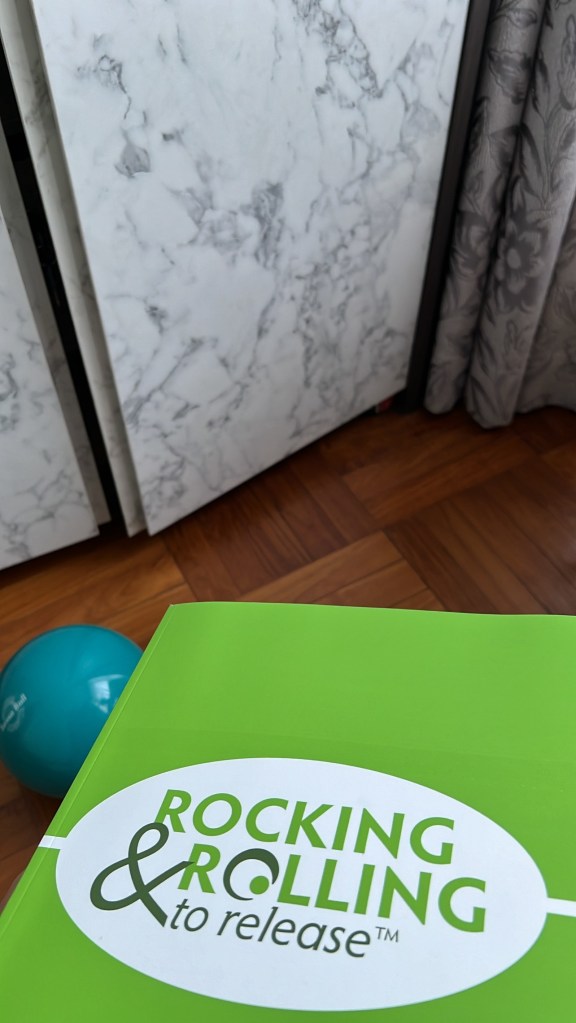
Last week, I completed advanced training in myofascial rocking techniques using Sensaballs. This approach supports fascial hydration, joint decompression, and nervous system regulation. This is ideal for clients with stiffness, chronic tension, or movement restrictions.
This course explored how gentle rocking and rolling techniques using Sensaballs can:
Release superficial and deep fascial restrictions
Improve proprioception and body awareness
Downregulate the nervous system
Restore more efficient movement patterns
What stood out most?
Using small, precise tools to create deep tissue change, it was a reminder that release doesn’t have to be aggressive to be effective. Subtle, intelligent input creates powerful change.
It reinforced something I believe deeply, which is that true strength is built on softness and awareness.
I’m really excited to integrate this more in my teaching and practice. Between myofascial release work and starting my pre/postnatal specialist training, I’m seeing how everything connects — fascia, breath, nervous system, core, recovery.
Teaching has taught me a lot about my favourite Bible verse, Proverbs 4:23.
The Architecture of Life: A Philosophical Exploration of Proverbs 4:23
“Above all else, guard your heart, for everything you do flows from it.” (Proverbs 4:23, NIV)
This ancient maxim from the Book of Proverbs is not merely a piece of religious advice; it is a comprehensive life philosophy that establishes the inner self as the primary driver of human existence. It argues that character precedes conduct, and internal state dictates external reality. By interpreting “heart” as the epicenter of thoughts, emotions, and volition, this verse challenges individuals to adopt a proactive, vigilant approach to personal development and ethical living.
The Heart as the Command Center
In biblical wisdom literature, the “heart” is rarely just the seat of romantic emotion. Rather, it represents the, “center of the personality or spiritual life,” encompassing the mind, will, and intellect. It is the “control room” of human behavior. The philosophy of Proverbs 4:23 dictates that all our actions—our words, decisions, and relationships—are simply overflows from this internal reservoir. If the heart is a polluted source, life becomes chaotic; if it is pure, life becomes orderly and productive.
The Philosophy of “Diligence”
The injunction to guard the heart “with all diligence” or “above all else” introduces a philosophy of radical prioritization. It implies that inner maintenance is more crucial than external achievements, wealth, or reputation.
Vigilance as Prevention: Just as a city requires a watchman to prevent invaders, the individual must protect their mind from bitterness, anxiety, fear, and negativity.
Proactive Curation: It is not enough to merely avoid evil; one must curate their internal environment. This involves filling the mind with truth, wisdom, and positivity.
Active Boundaries: It suggests setting boundaries on what we expose ourselves to—media, conversations, and relationships—as these are the “gateways” to our inner life.
“Everything You Do Flows From It”
This phrase highlights a direct cause-and-effect relationship between our internal state and our external life. The “issues of life” are the actions and consequences that “spring forth” from the heart.
The Impact on Decision-Making: When the heart is guarded and centered on virtue, it becomes easier to navigate complex moral situations. A clean heart produces wise, consistent choices.
The Impact on Relationships: A heart guarded against resentment or pride allows for healthier, more loving, and more genuine connections with others.
The Impact on Well-being: The state of the heart affects not just spiritual life, but also emotional and physical health, as chronic stress and negativity take their toll on the body.
A Modern Application
In a modern context, this philosophy translates to emotional intelligence and self-regulation. Instead of letting circumstances dictate our reactions, we are called to guard our internal response to those circumstances. It is a philosophy that encourages us to stop, reflect, and evaluate our thoughts before they turn into actions. It suggests that if we tend to our inner life, our external life will take care of itself.
Conclusion
Proverbs 4:23 offers a compelling, proactive, and holistic philosophy of life. It compels us to move beyond superficial improvements and to focus on the source of our humanity—the heart. By guarding our inner life with intense diligence, we ensure that the “springs” of our lives—our actions, words, and decisions—are life-giving, positive, and enduring. It is a call to become the architects of our own character, rather than mere victims of our circumstances.
Pilates has always lived in a space that’s slightly misunderstood. These days, it’s a workout—a precise system of strength, control, and alignment. But culturally and artistically, it behaves more like a language. The movements aren’t just functional shapes; they’re gestures, symbols, and narratives passed down through bodies rather than books. Joseph Pilates didn’t name exercises randomly—he named them like a choreographer or a poet would, embedding imagery and intention into form.
As such, the way I like to frame it is that Pilates is often like a movement system with artistic logic, on top of being a fitness modality.
It helps to know that Pilates emerged in a time and cultural context where physical culture, dance, and expressive movement were deeply intertwined. Joseph Pilates was working alongside dancers, performers, and people whose bodies were their instruments. In that world, movement wasn’t just about conditioning muscles — it was about clarity, control, and expression.
When you look at Pilates exercises through this lens, the names stop being decorative. You realise that Joseph Pilates didn’t name exercises randomly—he named them like a choreographer or a poet would, embedding imagery and intention into form.
Swan Dive: Technically, it’s about spinal extension, balance, and control. Artistically, it’s a study in trust and timing. There’s the aspect of yielding to gravity without collapsing, which mirrors moments in life where expansion requires vulnerability.
Teaser: Physically, the infamous teaser involves “everything working together“. Metaphorically, it can represent holding complexity with calm. In this sense, you also recognise thatTeaser is less about perfection and more about integration.
Tree: The Tree exercise involves one leg being grounded, with the spine tall (often where form is compromised, actually), similar to how growth requires a strong foundation.
In a sense, you see how Pilates encodes values into movement:
Control over chaos
Length over compression
Precision over excess
Flow over fragmentation
Isn’t it lovely how these values also reflect a philosophy of how a body should move through the world? In that sense, Pilates is quietly pedagogical, as it teaches a worldview through physical practice.
This also brings an extra layer of meaning to form in Pilates. While form exists to prevent injury or maximize output, it also exists to carry and express meaning, or embody symbolism.
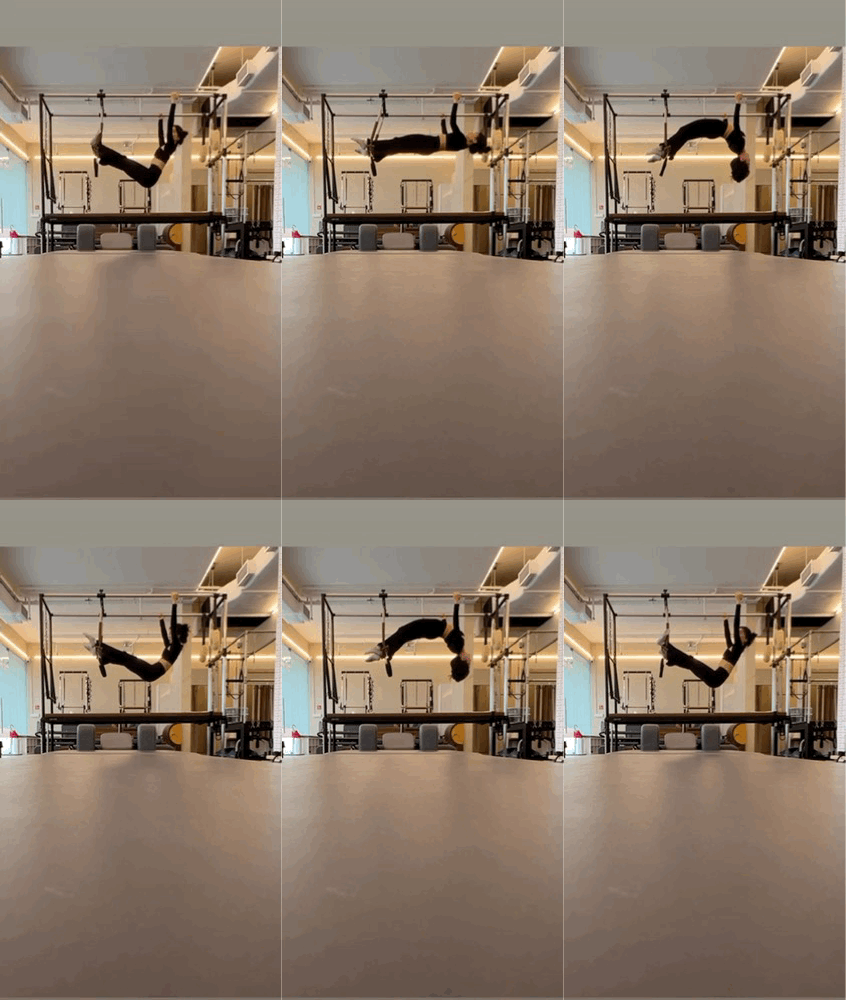
Here’s a look into Spread Eagle, a beautiful expression of “supported openness.”
Here’s an imperfect practice take of mine for Spread Eagle on the Cadillac.
Physically, the body:
Stands grounded through the legs on the trapeze
Opens the chest into space
Relies on the arms and back for support
Moves into vulnerability without collapsing
As a metaphor, Spread Eagle represents:
Expansion with structure — opening without losing integrity
Trust — leaning into space while staying connected
Confidence without force — lift rather than push
Receiving support while remaining upright
You could describe it as:
Learning how to open yourself to possibility while staying grounded in your base.
I’ve had the pleasure of guiding several people to their first Spread Eagle in the last few month and have been so happy to see their first hangs which have all been so beautiful. These have all been regular Pilates practitioners, but mainly on the reformer, so they are usually well acquainted with spinal articulation, have good upper body strength and not only good shoulder stability, but also the awareness of such a concept whether it was explicitly taught or not.
But also, I realise that a key element of the exercise people tend to miss is the importance of grounding with the legs and core (and hence the metaphor of a grounded extension). So sometimes you see things like legs becoming passive, feet “rest” on the bar instead of pressing, the body hanging from the shoulders instead of being supported from below.
As such, a wonderful prep is to execute Hip Rolls, the variation where the feet are on the Trapeze and the hands press down onto the Rolldown Bar. Another prep I like is to first execute the choreography in a vertical position, which is a textbook prep. and a nice variation I learned from my private instructor is to have the hands initially hold the fuzzies, rather than immediately grip the horizontal bars, with feet in the trapeze strap.
Luckily for me, my clients are great at multi-step cueing (having been victimised with my extensive verbal cueing in group classes before) and generally hardly overwhelmed by multiple alignment points in a single movement. This is important because of the sagittal plane spinal movements one flows through here => Neutral – Flexion – Neutral – Extension – Flexion – Neutral. They are also easily confident with standing on the Cadillac, due to extensive experience with standing exercises on a rather tall reformer with a moving carriage element.
The biggest hurdle was often grip strength, which can be trained by deadhangs and other specific grip strength training techniques which I won’t delve into as I’ve yet to study this deeper.
1. The “10% serendipity rule” is an informal principle that suggests proactively engaging in a small percentage of unplanned or slightly uncomfortable activities to increase the likelihood of fortunate, unexpected discoveries or opportunities. It is not a fixed rule but rather a mindset for inviting more “active luck” into one’s life.
The core idea is to say “yes” to approximately 10% more events, coffees, workouts, or social interactions than you might typically feel inclined to do. The principle argues that while staying in your comfort zone has zero upside for unexpected opportunities, stepping outside it—even slightly—creates ripple effects with unlimited potential benefits you could not have predicted.
2. Opportunity cost, diminishing marginal returns, and comparative advantage
When economists try to describe people’s preferences, they assume that marginal utility of a good is decreasing. In other words, if we have very little of something, getting more of it makes us very happy. If we have already a lot of it, we care a lot less. For example, $20 seem like a fortune to a child, but like a drop in the bucket to a billionaire.
3. “The only way to develop true confidence is to earn it.
The confidence that you can bounce back from failure is earned by working through previous failures.
The confidence that you can deliver the speech is earned by the previous speeches you have given.
The confidence that you can perform on game day is earned by the previous performances in practice.
In the beginning, you need enough courage to practice even though it may not go very well. And over time, as your skills improve, courage transforms into confidence. Courage first, confidence later.”




 rosalinda.blog