
Pilates has always lived in a space that’s slightly misunderstood. These days, it’s a workout—a precise system of strength, control, and alignment. But culturally and artistically, it behaves more like a language. The movements aren’t just functional shapes; they’re gestures, symbols, and narratives passed down through bodies rather than books. Joseph Pilates didn’t name exercises randomly—he named them like a choreographer or a poet would, embedding imagery and intention into form.
As such, the way I like to frame it is that Pilates is often like a movement system with artistic logic, on top of being a fitness modality.
It helps to know that Pilates emerged in a time and cultural context where physical culture, dance, and expressive movement were deeply intertwined. Joseph Pilates was working alongside dancers, performers, and people whose bodies were their instruments. In that world, movement wasn’t just about conditioning muscles — it was about clarity, control, and expression.
When you look at Pilates exercises through this lens, the names stop being decorative. You realise that Joseph Pilates didn’t name exercises randomly—he named them like a choreographer or a poet would, embedding imagery and intention into form.
- Swan Dive: Technically, it’s about spinal extension, balance, and control. Artistically, it’s a study in trust and timing. There’s the aspect of yielding to gravity without collapsing, which mirrors moments in life where expansion requires vulnerability.
- Teaser: Physically, the infamous teaser involves “everything working together“. Metaphorically, it can represent holding complexity with calm. In this sense, you also recognise thatTeaser is less about perfection and more about integration.
- Tree: The Tree exercise involves one leg being grounded, with the spine tall (often where form is compromised, actually), similar to how growth requires a strong foundation.
In a sense, you see how Pilates encodes values into movement:
- Control over chaos
- Length over compression
- Precision over excess
- Flow over fragmentation
Isn’t it lovely how these values also reflect a philosophy of how a body should move through the world? In that sense, Pilates is quietly pedagogical, as it teaches a worldview through physical practice.
This also brings an extra layer of meaning to form in Pilates. While form exists to prevent injury or maximize output, it also exists to carry and express meaning, or embody symbolism.
Here’s a look into Spread Eagle, a beautiful expression of “supported openness.”
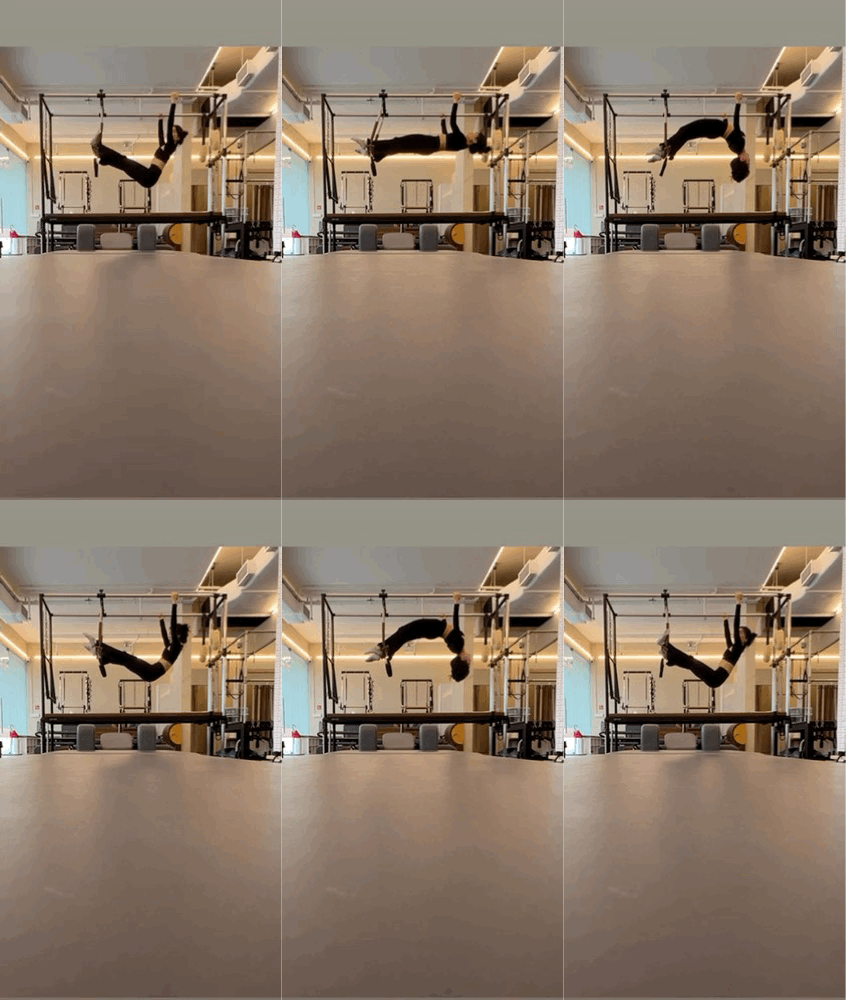
Here’s an imperfect practice take of mine for Spread Eagle on the Cadillac.
Physically, the body:
- Stands grounded through the legs on the trapeze
- Opens the chest into space
- Relies on the arms and back for support
- Moves into vulnerability without collapsing
As a metaphor, Spread Eagle represents:
- Expansion with structure — opening without losing integrity
- Trust — leaning into space while staying connected
- Confidence without force — lift rather than push
- Receiving support while remaining upright
You could describe it as:
Learning how to open yourself to possibility while staying grounded in your base.
I’ve had the pleasure of guiding several people to their first Spread Eagle in the last few month and have been so happy to see their first hangs which have all been so beautiful. These have all been regular Pilates practitioners, but mainly on the reformer, so they are usually well acquainted with spinal articulation, have good upper body strength and not only good shoulder stability, but also the awareness of such a concept whether it was explicitly taught or not.
But also, I realise that a key element of the exercise people tend to miss is the importance of grounding with the legs and core (and hence the metaphor of a grounded extension). So sometimes you see things like legs becoming passive, feet “rest” on the bar instead of pressing, the body hanging from the shoulders instead of being supported from below.
As such, a wonderful prep is to execute Hip Rolls, the variation where the feet are on the Trapeze and the hands press down onto the Rolldown Bar. Another prep I like is to first execute the choreography in a vertical position, which is a textbook prep. and a nice variation I learned from my private instructor is to have the hands initially hold the fuzzies, rather than immediately grip the horizontal bars, with feet in the trapeze strap.
Luckily for me, my clients are great at multi-step cueing (having been victimised with my extensive verbal cueing in group classes before) and generally hardly overwhelmed by multiple alignment points in a single movement. This is important because of the sagittal plane spinal movements one flows through here => Neutral – Flexion – Neutral – Extension – Flexion – Neutral. They are also easily confident with standing on the Cadillac, due to extensive experience with standing exercises on a rather tall reformer with a moving carriage element.
The biggest hurdle was often grip strength, which can be trained by deadhangs and other specific grip strength training techniques which I won’t delve into as I’ve yet to study this deeper.
 rosalinda.blog
Leave a comment